In uscita a settembre 2026
pp. 250
COLLANA: Studi e dialoghi giuridici – 22
ISBN: 979-12-82274-14-2
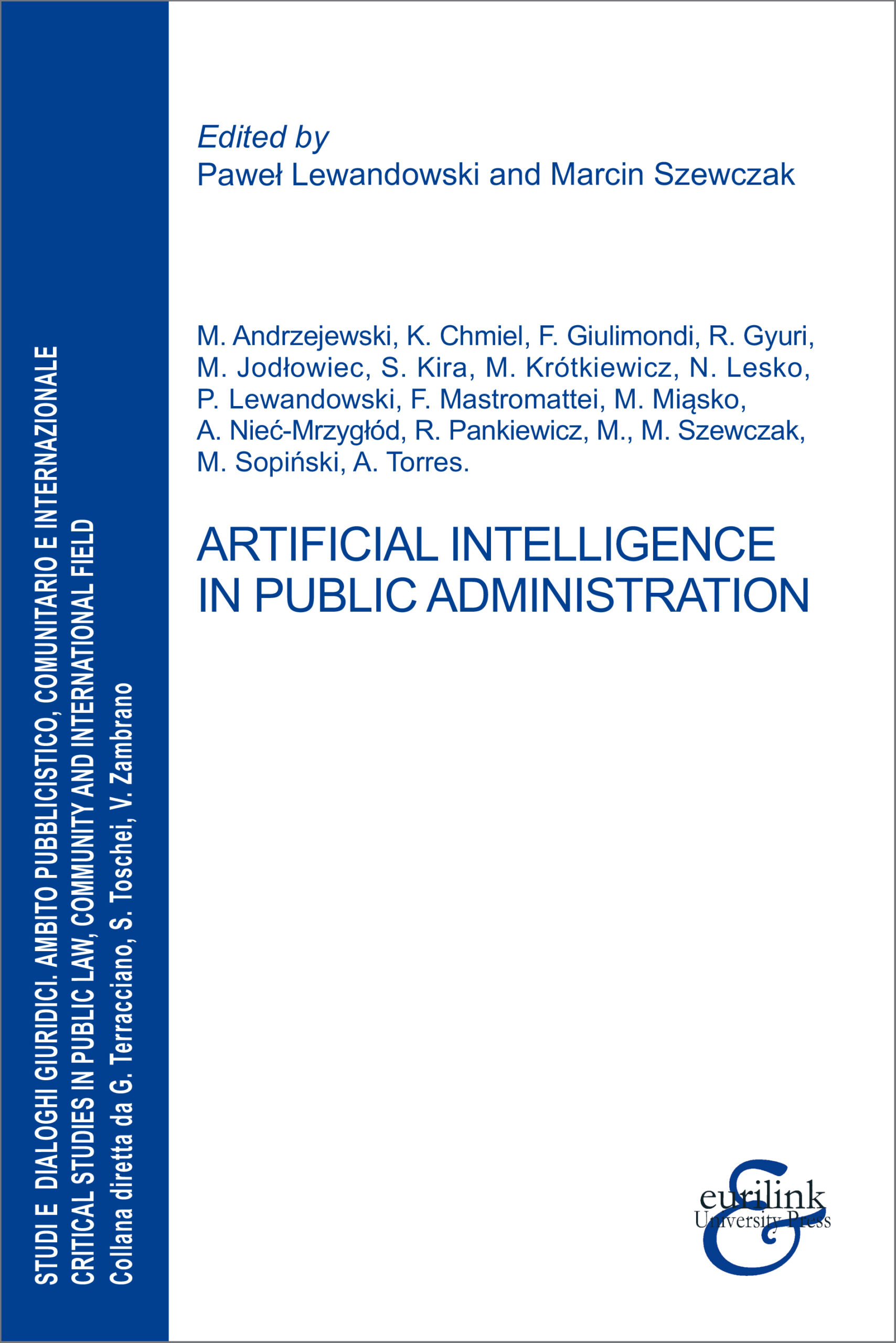
Edited by Paweł Lewandowski and Marcin Szewczak
Artificial Intelligence (AI) is changing the world of work at a rapid pace, as it can be used to optimize or automate processes and, if necessary, achieve results more efficiently. AI is also playing an increasingly important role in public administration – and not just since the publication of ChatGPT. However, AI is not being used in a uniform and structured way, but to very different extents at all levels of administration. There are currently no comprehensive, binding standards for the use of AI in public administration. This regulatory void represents a significant compliance gap. Without a clear framework, there is a risk that AI systems will be used inappropriately, which poses not only legal but also ethical and social risks. In the public debate surrounding AI, the focus is usually on data protection. While this is undoubtedly a key issue, this focus falls short. AI compliance must be thought of in a more comprehensive way and also include aspects such as transparency, traceability of decisions, fairness, non-discrimination, auditability and accountability. this is the only way to ensure the holistic and trustworthy use of AI in public administration. The aim of this monograph is to present the multifaceted aspects of AI implementation in public administration, to facilitate the exchange of experiences, and to discuss the potential applications, opportunities, and challenges associated with artificial intelligence in public administration.
Paweł Lewandowski – Assistant Professor in the Department of Public and Constitutional Church Law at the John Paul II Catholic University of Lublin, as well as a University Professor and Vice Dean of the College of Legal Sciences at the Nicolaus Copernicus Superior School in Lublin. He earned his Ph.D. in law with honours from John Paul II Catholic University of Lublin and furthered his expertise at the Jagiellonian University and the University of Miskolc (Hungary). His extensive international experience includes numerous internships and research fellowships, including in the United States, Spain, Portugal, Italy, the Czech Republic, Slovakia, Ukraine, and Lebanon, carried out under the Polish National Agency for Academic Exchange, Erasmus+ Programme, and Guest Lecture.
Marcin Szewczak – PhD, Hab. University Professor at the Department of Local Government Law and Administration Science, Faculty of Law, Canon Law and Administration of John Paul II Catholic University of Lublin. A graduate of the following faculties: law (KUL) and international relations (UMCS). He holds a Master of Arts in European Studies and Global Affairs from the Sante Cuore University in Milan and the Peter Pazman Catholic University in Budapest. In his scientific and professional work, he focuses on issues related to local government law and EU law, in particular regional development law and local government international cooperation.
Authors:
Maciej Andrzejewski, Kamila Chmiel, Fabrizio Giulimondi, Róbert Gyuri, Marcin Jodłowiec, Solomiia Kira, Marek Krótkiewicz, Nataliia Lesko, Federico Mastromattei, Mariusz Miąsko, Anna Nieć-Mrzygłód, Ryszard Pankiewicz, Michal Roháč, Michał Sopiński, Alejandro Torres.